
<!DOCTYPE html>
<html <?php language_attributes(); ?>>
<head>
<meta charset="<?php bloginfo('charset'); ?>"/>
<title>
<?php if (is_home() || is_front_page()) {
echo bloginfo('name');
} else {
echo "» ";
echo wp_title('');
echo " | ";
echo bloginfo('name');
} ?>
</title>
<!-- START Angaben aus non-optimized Template -->
<meta name="author" content="Elias Danner"/>
<meta name="revisit-after" content="5 days"/>
<meta name="robots" content="index"/>
<meta http-equiv="imagetoolbar" content="false"/>
<!-- ###
<meta name="page-topic" content="Oberrhein Römer-Radweg, Radfahren, Sport, Radweg, Römer, Geschichte"/>
<meta name="keywords" content="oberrhein, breisgauer, römer, radweg, radfahren, weg, bewegung, ausflug, freizeit, sport, erholung, geschichte, lehrpfad, spuren, markgräflerland, breisgau, süddeutschland, badenweiler, müllheim, heitersheim, bad krozingen, breisach, sasbach, jechtingen, riegel, tourismus"/>
<meta name="description" content="Oberrhein Römer-Radweg durch Markgräflerland & Kaiserstuhl. 140 km Radwandervergnügen zu Römern, Rhein und Reben von Grenzach-Wyhlen bis Riegel."/>
END non-optimized Template ### -->
<meta http-equiv="X-UA-Compatible" content="IE=edge">
<meta name="viewport" content="width=device-width, user-scalable=no">
<!-- ####### STYLESHEETS & LINKS ####### -->
<!-- Allgemeines Stylesheet -->
<link rel="stylesheet" type="text/css" href="<?php bloginfo('stylesheet_url'); ?>">
<link rel="stylesheet" type="text/css" href="<?php bloginfo('template_url'); ?>/jquery-aselect.css">
<!-- Fonts -->
<link href='https://fonts.googleapis.com/css?family=Raleway:400,100,300,200,500,600,700,800,900' rel='stylesheet'
type='text/css'>
<link href='https://fonts.googleapis.com/css?family=Nunito:400,300,700' rel='stylesheet' type='text/css'>
<link href='https://fonts.googleapis.com/css?family=Roboto:400,100,100italic,300,300italic,400italic,500,500italic,700,700italic,900,900italic'
rel='stylesheet' type='text/css'>
<link href='https://fonts.googleapis.com/css?family=Oxygen:400,300,700' rel='stylesheet' type='text/css'>
<link href="<?php bloginfo('template_url'); ?>/favicon.ico" rel="shortcut icon"/>
<link rel="pingback" href="<?php bloginfo('pingback_url'); ?>"/>
<!-- ### END ### -->
<!-- ####### CODE PLUGINS ####### -->
<?php wp_head(); ?>
<!-- ### END PLUGINS ### -->
<!-- Custom Styles -->
<style type="text/css">
html {
background: url(
<?php
// Hier einfach die jeweiligen Hintergründe ergänzen oder entfernen.
if ( is_front_page() ){ bloginfo('template_url'); ?>/images/bg.jpg <? }
else { bloginfo('template_url'); ?>/images/bg_service.jpg<?php } ?> ) no-repeat center center fixed;
}
@media screen and (max-width: 730px) {
html {
background-position: top;
}
}
</style>
<script type="text/javascript">
$(document).ready(function () {
$(".mobile_nav_button p, .mobile_nav_button img").click(function (event) {
event.preventDefault();
$('div.menu-navigation-container #dropmenu').slideToggle('slow');
});
});
// $(document).ready(function () {
// $('.mobile_nav_button').toggle(function() {
// $('div.menu-navigation-container #dropmenu').slideDown();
// $('.mobile_nav_button').addClass("active");
// }, function() {
// $('div.menu-navigation-container #dropmenu').slideUp();
// $('.mobile_nav_button').removeClass("active");
// });
// });
</script>
<!-- HTML5 shim and Respond.js IE8 support of HTML5 elements and media queries -->
<!--[if lt IE 9]>
<script src="<?php bloginfo('template_url'); ?>/js/assets/html5shiv.js"></script>
<script src="<?php bloginfo('template_url'); ?>/js/assets/respond.min.js"></script>
<![endif]-->
</head>
<!-- ####### INHALT ####### -->
<body>
<?php if (!is_front_page()) { ?>
<!-- Auswahl Sprache -->
<div id="selection"><a href="?lang=de"><img src="<?php bloginfo('template_url'); ?>/images/de.jpg"
class="selection-button" border="0"/></a> <a href="?lang=en"><img
src="<?php bloginfo('template_url'); ?>/images/en.jpg" class="selection-button" border="0"/></a> <a
href="?lang=fr"><img src="<?php bloginfo('template_url'); ?>/images/fr.jpg" class="selection-button"
border="0"/></a> <a target="_blank"
href="http://www.facebook.com/roemerradweg"><img
src="<?php bloginfo('template_url'); ?>/images/facebook_logo.png" class="selection-button"
border="0"/></a></div>
<?php } ?>
<!-- Die Seite ist in drei Bereiche eingeteilt: Den Header mit Logo und Navigation, den Content Bereich mit Sidebar und Inhalt sowie den Footer. -->
<div class="container<?php if (is_front_page()) {
echo "-frontpage";
} ?>">
<?php if (!is_front_page()){ ?>
<!-- HEADER START-->
<header class="fullwidth">
<!-- LOGO -->
<div id="logo" class="col1"><a href="/">
<img src="<?php bloginfo('template_url'); ?>/images/logo.jpg" border="0" width="165"
height="165"></a></div>
<!-- NAVIGATION -->
<div class="col2" id="navigation">
<div id="slogan">
<p><?php if (qtrans_getLanguage() == "de") : ?> Oberrhein Römer-Radweg durch Markgräflerland, Kaiserstuhl & Ortenau
<?php endif ?> <?php if (qtrans_getLanguage() == "en") : ?> Roman cycleway in Upper Rhine region through Markgräflerland, Kaiserstuhl & Ortenau
<?php endif ?><?php if (qtrans_getLanguage() == "fr") : ?> La piste cyclable du régions Rhin Supérieur par Markgräflerland, Kaiserstuhl & Ortenau<?php endif ?></p>
</div>
<div id="menu">
<a href="#" class="mobile_nav_button"><img class="menu_button"
src="<?php bloginfo('template_url'); ?>/images/menu_button.png"
height="43" width="43" alt="Menü">
<p>Navigation</p></a>
<?php wp_nav_menu(array('container' => 'nav', 'menu_id' => 'dropmenu', 'theme_location' => 'primary')); ?>
<?php wp_nav_menu(array('container' => 'div', 'menu_id' => 'dropmenu', 'menu_class' => 'menu-mobile', 'theme_location' => 'primary')); ?>
</div>
<div id="logo-mobile"><a href="<?php echo get_site_url();
?>/"><img src="<?php bloginfo('template_url'); ?>/images/logo.jpg" border="0" width="165"
height="165"></a></div>
</div>
<!-- NAVIGATION ENDE -->
</header>
<!-- HEADER END -->
<?php } else{ ?>
<div id="logo" class="frontpage"><a href="<?php echo get_site_url();
?>/"><img src="<?php bloginfo('template_url'); ?>/images/logo.jpg" border="0" width="165" height="165"></a>
</div>
<!-- Auswahl Sprache -->
<div id="selection-frontpage"><a href="?lang=de"><img src="<?php bloginfo('template_url'); ?>/images/de.jpg"
class="selection-button" border="0"/></a> <br class="break">
<a href="?lang=en"><img src="<?php bloginfo('template_url'); ?>/images/en.jpg" class="selection-button"
border="0"/></a><br class="break"> <a href="?lang=fr"><img
src="<?php bloginfo('template_url'); ?>/images/fr.jpg" class="selection-button" border="0"/></a><br
class="break"> <a target="_blank" href="http://www.facebook.com/roemerradweg"><img
src="<?php bloginfo('template_url'); ?>/images/facebook_logo.png" class="selection-button"
border="0"/></a></div>
<?php } ?>
About the Roman history of the region
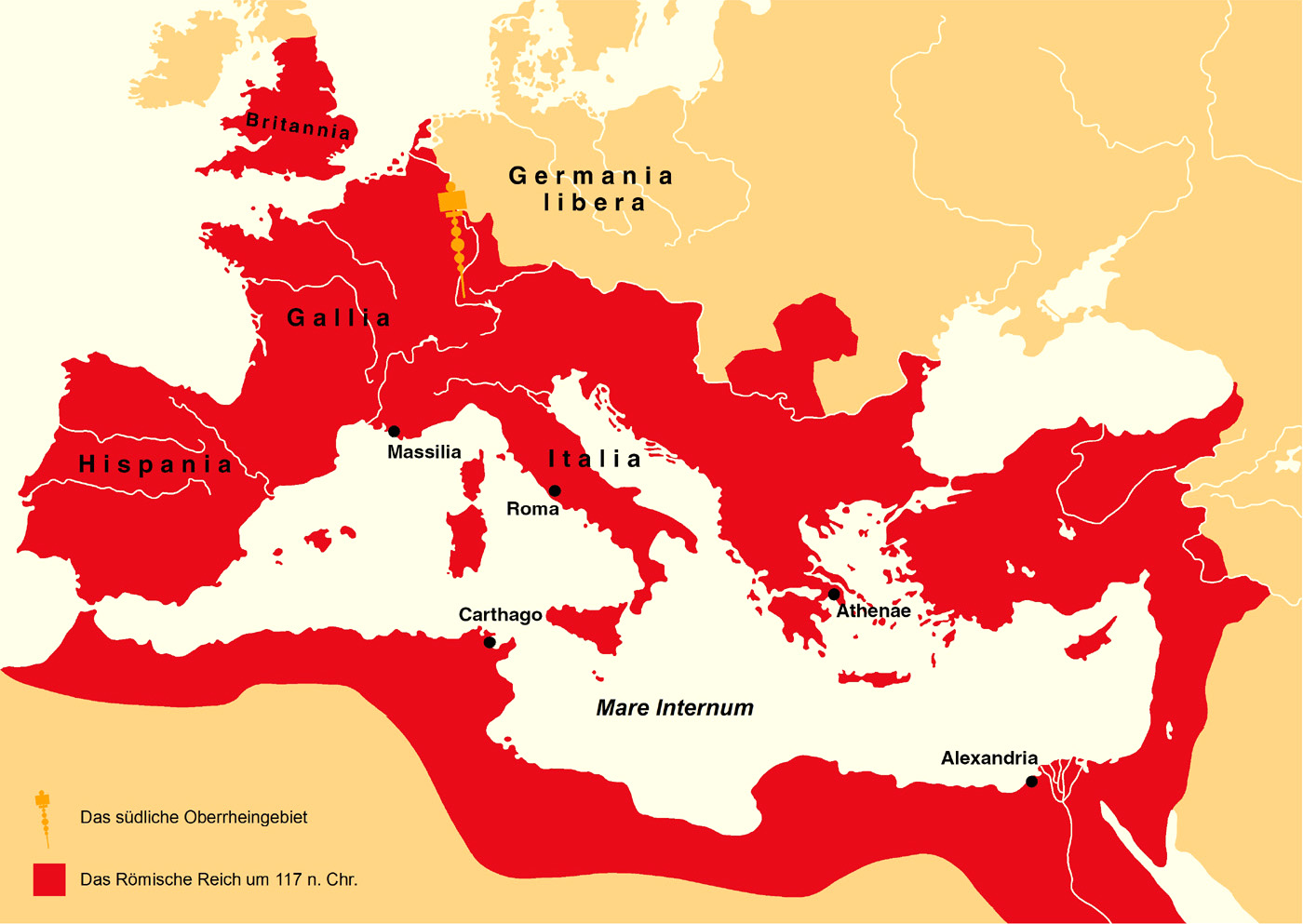
The southern Upper Rhine region is an old Roman arable land. During the reign of Gaius Julius Caesar the Rhine became the Roman imperial frontier. In the early 1st century the territories on the eastern bank of the Rhine river were secured by the Roman military. There were military bases in Riegel at the northern edge of the Kaiserstuhl and on the Limberg close to Sasbach and nearby Offenburg. Along the long-distance road from Augst to Mainz Roman service areas had been installed close to Herbolzheim, Friesenheim and Hohberg-Niederschopfheim.
Within the Roman Empire the Upper Rhine region became densely populated by civilians. First, Roman farms had been built close to Grenzach, Auggen and Heitersheim and later they were extended to enormous estates. Numerous estates were discovered along the Upper Rhine; e. g. nearby Wyhlen, Rheinfelden-Nollingen and Lörrach-Brombach, Fischingen, Efringen-Kirchen and Kenzingen. At that time, larger settlements had been built in Bad Krozingen, Lahr and Offenburg. Remains of the Roman iron ore mining industry were discovered close to Bad Bellingen, Schliengen, Ringsheim, Ettenheim and Mahlberg. A curative spring was the origin of Badenweiler’s settlement. Subsequently, around this spring the Romans built up the biggest thermal spa on the right bank of the Rhine river. The colony of Riegel was an administrative centre with an important market basilica.
After having lost the territory of the Province Germania Superior on the right bank of the Rhine river in the 3rd century, the Romans fortified the Rhine frontier again. In the 4th century they built Roman fortifications along the Rhine river; e. g. the bridge castle nearby Wyhlen, the fort on the Münsterberg in Breisach and the fortlet in Jechtingen. This Danube-Iller-Rhine Limes, constructed in the late antiquity, represented the last Roman frontier in this region and it was in existence until the 5th century.